“What’s the big deal about climate change” is often how the question is posed in class, at home, or by your friends. It’s a fair question because if it isn’t a “big deal” then we really don’t need to worry about it, right? Unfortunately the answer - that is, the explanation of why climate change is a big deal - isn’t a simple one; the problem itself defies simplicity and explaining it to a public that increasingly distrusts science and expertise is nearly impossible. Nevertheless, I hope you will trust me and my 25 years of training and experience as a scientist and educator; please read on.
First on our list of things to cover is a functional definition of climate change. The text I use in my classes defines it this way: climate change is “a directional change to the global climate that lasts for three decades or more.” They contrast climate change with weather; “the state of the atmosphere with respect to heat or cold, wetness or dryness, calm or storm, clearness or cloudiness” (Merriam-Webster). Thus, weather is a day to day phenomenon and climate is a decadal phenomenon.
The next item to discuss are the factors that influence the climate we experience across decades. The United States National Academy of Sciences – the preeminent scientific body in the world – has released dozens of reports on climate science over the past two decades. They describe the factors that contribute to climate variability in a 2016 report;
“Natural climate variability arises from two different sources: (1) internal variability from interactions among components of the climate system, for example, heat transfer between the ocean and the atmosphere or within varying depths of the ocean, and (2) natural external forcings that can push Earth toward warming or cooling, for example, volcanic eruptions and solar variations. Changes in human-caused factors, such as the emission of greenhouse gases (GHGs) and aerosols, also exert external forcing on the climate system. The climate we experience is the combination of all of these factors.”
So, climate change itself is normal and occurs as the result of natural climate variability. However, there is also a human-caused component of climate change related to greenhouse gasses including, among other gasses, carbon dioxide released by the combustion of fossil fuels. So, what’s the big deal about greenhouse gasses?
Greenhouse Gasses such as carbon dioxide (as well as methane, nitrous oxides, and water vapor) trap heat in our atmosphere (Figure 1) and this is a good thing. Without greenhouse gasses, we wouldn’t be here on Earth! Greenhouse gasses make the Earth habitable for living things like you and me and trees and honey badgers. Greenhouse gasses created the conditions that allow life to flourish! However, too much of a good thing can be bad and this is the case with global climate change; too much carbon dioxide is being released by people into the atmosphere.
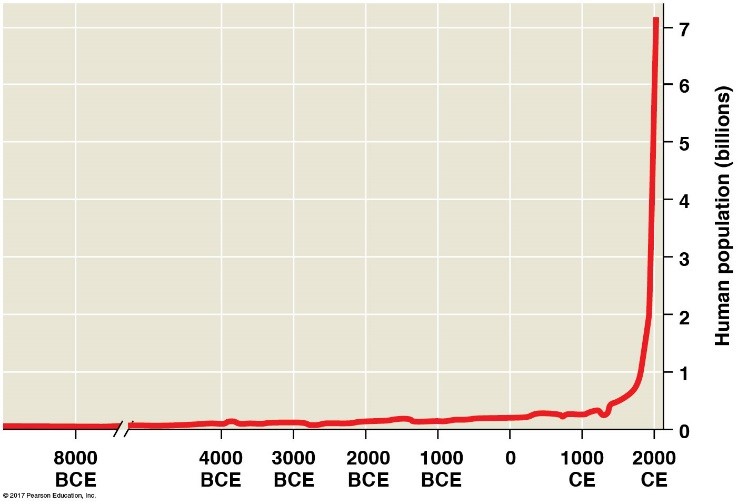
Our next question is “how do people influence the amount of carbon dioxide in the atmosphere?” This is also a good question and one that seems to have a simple biological explanation. People, along with every other living thing on the planet, emit carbon dioxide through cellular respiration; we exhale it with every breath! And the human population is increasing exponentially (Figure 2) so this must be the answer to our original question: the big deal is too many humans on the planet! No, unfortunately that’s just too simple an explanation.
Globally on an annual basis, the amount of carbon dioxide in the atmosphere is kept in balance, more or less, by the work of photosynthesizing organisms – algae, bacteria, and plants – that soak up CO2 to make sugars. This is what we call the carbon cycle. Volcanoes also emit carbon dioxide into the atmosphere but this is sporadic and the rate of volcanic eruptions has been generally constant over time (but, see below). So if it isn’t the increase in the human population that is leading to increased carbon dioxide in the atmosphere, what is it? Well, it isn’t the human population explosion directly but rather our need to heat our homes and cook our food. This next point requires a bit more explanation of the carbon cycle.
The Earth is basically a closed system (not technically but bear with me) that contains all of the carbon, nitrogen, oxygen, and other elements that we need to live in a finite amount; never to substantially increase or decrease. Carbon from the atmosphere is incorporated by photosynthesizing organisms – algae, bacteria, and plants – into the cells and tissues of those organisms. Ultimately all of that carbon will return to the atmosphere as the organisms respire or die and decompose. However, some of the atmospheric carbon has been sequestered, or locked away, in the tissues of ancient organisms; primarily plants. During the Carboniferous Period 350 million years ago, the Earth was much warmer and wetter and had much higher concentrations of CO2 in the atmosphere. Back then there were massive forests of ferns, basically, like you’ve never seen before; it was a good time to be a plant! There was so much plant life and the planet was so wet that many of these ancient “trees” fell in bogs or lakes and didn’t decompose very well or at all. That is, they incorporated the carbon dioxide from the atmosphere and locked it away… for 350 million years! Through the intervening years and the combined effect of chemical, temperature, and pressure changes, these ancient sources of carbon (that is, the ancient “trees”) became what we call fossil fuels; the vast deposits of coal, oil, and natural gas that we burn today.
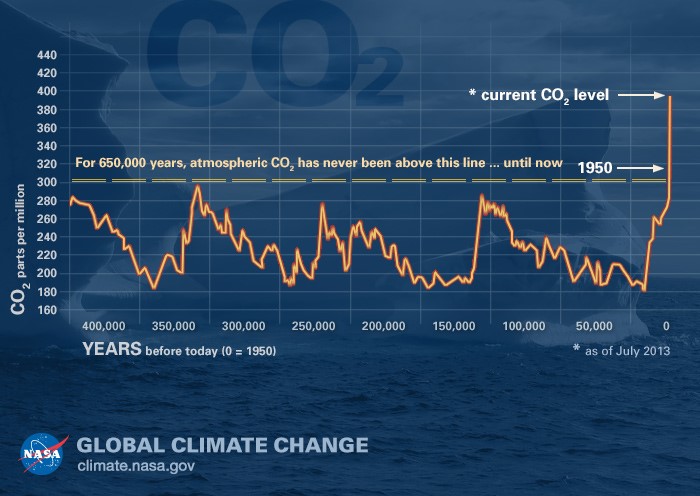
So you see, the global climate changed slowly over millions of years and as the carbon dioxide was removed from the atmosphere, the average global temperature cooled (remember, CO2 is a greenhouse gas, see Figure 1). The “new normal” of balance between atmospheric carbon dioxide levels and global temperature remained fairly constant at this lower level for the past several million years with minor oscillations (Figure 3).
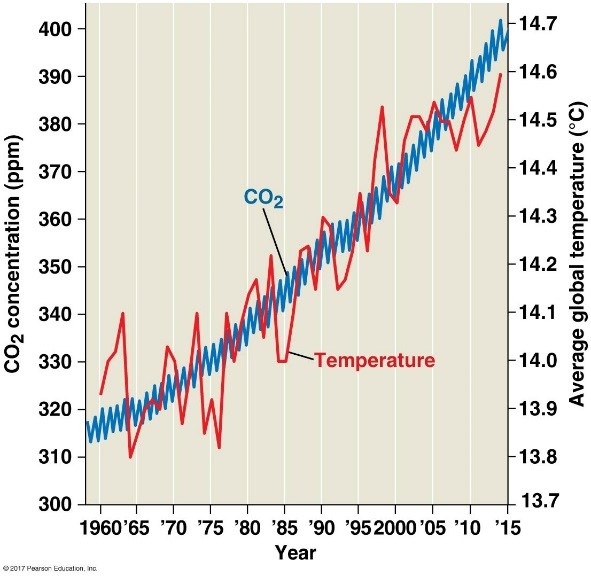
As must be evident to you now, the problem really began once we discovered fossil fuels, their abundance, and their usefulness as an energy source. Following the Industrial Revolution (ca. 1760 - 1840 CE) the human population really began to grow (Figure 2) and all of these folks began using coal, and later oil and gas, to heat their homes, cook their food, and move them about the planet. Indeed, consider the change in carbon dioxide levels and average global temperature since the 1950s (Figure 4).
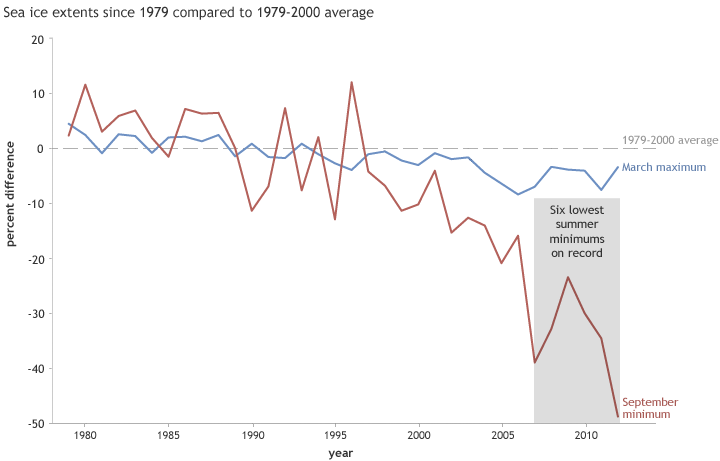
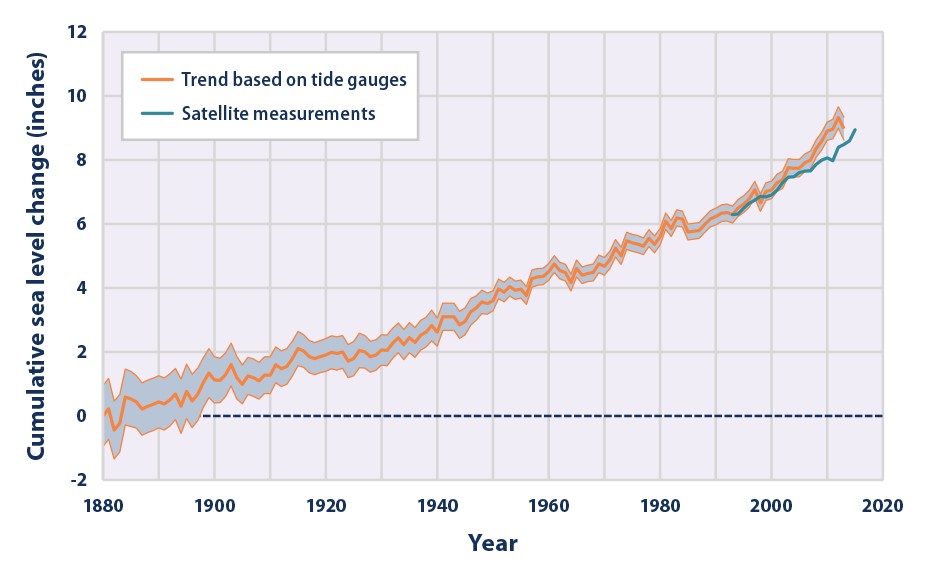
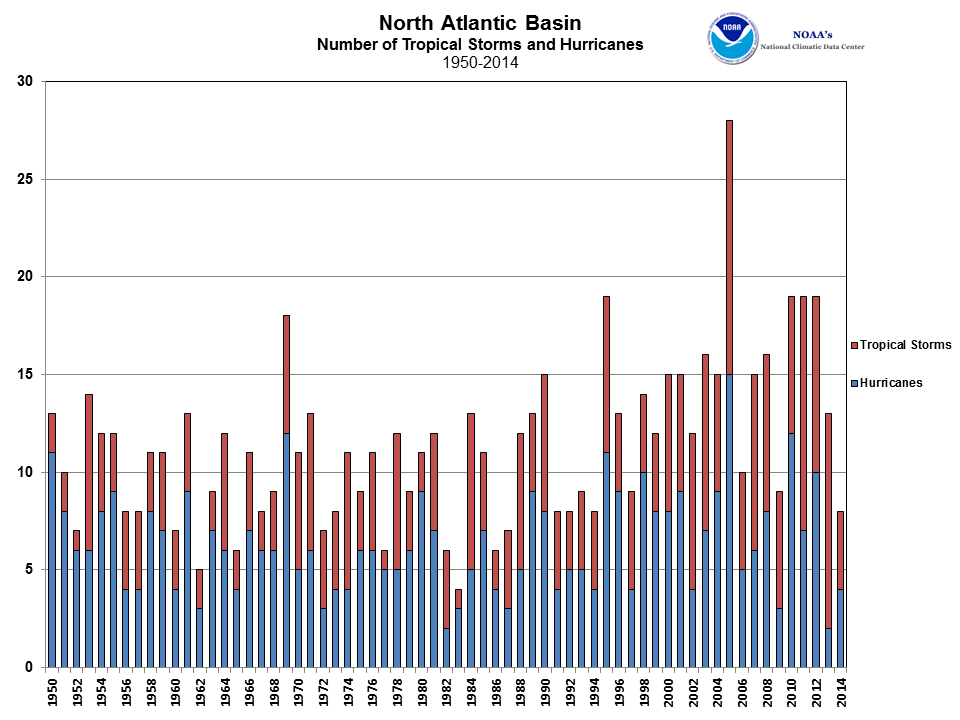
You can also now see, the problem with global climate change isn’t the increase in the human population directly. Rather the problem is a result of the energy source that we “discovered” and subsequently made the center of a global marketplace that seven billion people rely on. As the human population grows, reliant upon fossil fuels, more greenhouse gasses like carbon dioxide will accumulate in the atmosphere and these gasses will do what they’re good at; trap heat leading to increased average global temperatures (Figure 4), melting sea ice (Figure 5), rising sea levels (Figure 6), erratic and intense storms (Figure 7), and immense damage in terms of coastal ecosystems and human population centers (think, Hurricane Maria most recently).
Where do we go from here? Let’s return to our original question: “What’s the big deal about climate change?” I think you will agree that global climate is constantly changing and, perhaps, that humans have influenced this change since the Industrial Revolution. Yet, is it a big deal? Well, yes it is. It’s a big deal because the previous changes in global climate that we’ve discussed took place over hundreds of millions of years. The big deal with global climate change is the pace at which the climate is changing and what we know about the consequences of dramatic climatic change. About 250 million years ago there was just such a change in the global climate preceded by a period of intense volcanism; it was called the Permian Mass Extinction. In this case the global climate became much warmer (about 6° C) following the release of tons (literally) of CO2 into the atmosphere (recall what greenhouse gasses do!). This event is known in popular science as “The Great Dying.” Huge numbers of plant and animal species were wiped out, totally extinct, and this happened over a very short period in geologic time; about 500K years. Compare that to what is happening today. We’ve seen the average global temperature increase about 1° C in less than 500 years! That is much too fast of a change for plants and animals to adapt to, or to move to a more hospitable area. If plants or animals cannot adapt or move, they go extinct. Perhaps more importantly, centers of agricultural production around the world will shift toward higher latitudes north and south. Unfortunately these areas are already occupied by cities and suburbs with their impermeable asphalt and concrete surfaces or by forests and desserts that possess relatively poor soils for growing crops. You see, we already have all of the best soils in the World under cultivation and we’ve built our population centers around them. It’s uncertain in this scenario if agricultural production will be able to sustain the yields that we currently enjoy and depend upon to feed the Earth’s estimated population of 11 billion people by 2030. And that, my friends, is a very big deal.