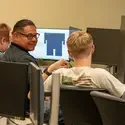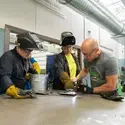
When Eagle Oral Surgery needed specialized IV training for its Surgical Dental Assistants, College of Western Idaho (CWI) Workforce Development created a new course to meet the employer's specific needs. The two-day IV Basics course was delivered to Eagle Oral Surgery employees in August at CWI's Canyon County Center (CYNC), combining classroom instruction with hands-on practice to prepare participants to safely and effectively start IVs in their workplace.
Eagle Oral Surgery first approached CWI Workforce Development in spring looking for a local training option. With a busy patient schedule, developing and delivering a comprehensive IV training program internally was not feasible for the clinic.
CWI Workforce Development Emergency Medical Services (EMS) Program Coordinator, Shayne Cluck, developed the course specifically around the clinic's needs.
“This was a brand-new course custom built specifically for Eagle Oral Surgery,” Cluck said. “We didn't just tweak an existing slide deck. We built a unique, context-specific curriculum tailored to their exact clinical environment.”
Throughout June, CWI worked to identify the clinic's training needs, review evidence-based guidelines, and align the course with established clinical standards. Cluck developed the curriculum in July, drawing on his 16 years of EMS field experience, 10 years in education, and concepts from CWI's Advanced Emergency Medical Technician curriculum.
While the mechanics of starting an IV are similar across healthcare settings, Cluck said the course needed to reflect where Eagle Oral Surgery employees would use the skill.
“In EMS, we are often working in low light, moving vehicles, or cramped quarters with critically ill patients,” Cluck said. “In an oral surgery setting, you are working in a well-lit, controlled environment with generally stable patients undergoing elective procedures.”
The resulting course covered anatomy and physiology, aseptic technique, equipment selection, fluid and pharmacology basics, medication dosage calculations, and the mechanics of venipuncture.
Participants then put those lessons into practice in the CYNC lab.
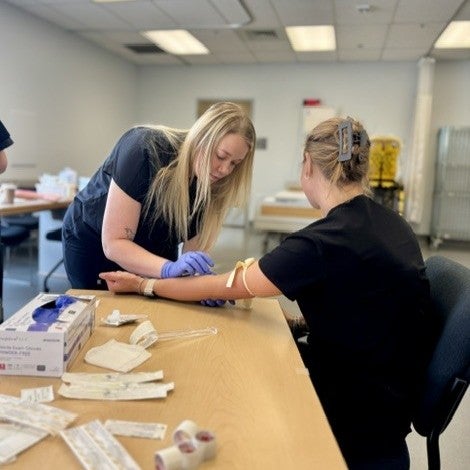
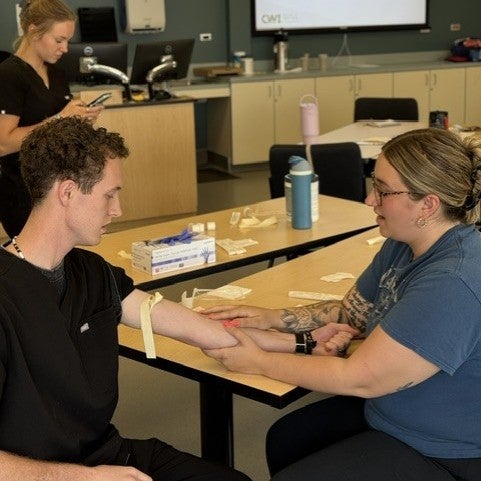
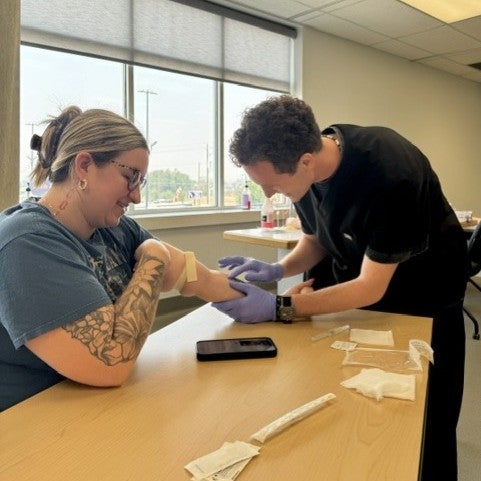
The hands-on portion began with equipment familiarization before students moved to simulation arms with active simulated blood flow. Participants practiced identifying veins, preparing sites, placing IVs, and securing lines while becoming familiar with different catheter styles, tubing, and accessories.
After demonstrating those skills on the simulation equipment, participants progressed to supervised live IV starts on one another. By the end of the second day, all four Surgical Dental Assistants had successfully completed three consecutive IV starts.
The training allows the Surgical Dental Assistants to perform the skill within their facility, helping Eagle Oral Surgery distribute responsibilities among its clinical team and allowing other providers to focus on higher-level medical interventions.
The course also highlights CWI Workforce Development's ability to respond to specific employer training needs. After Eagle Oral Surgery first approached CWI in the spring, the department worked with the employer to identify its needs, develop the curriculum, and deliver the training in August.
“What I am most proud of is how seamlessly our teams came together to solve a real industry challenge,” Cluck said. “It proves how agile and adaptable our Workforce Development department is when local employers identify a gap in their training.”
For more information about CWI's Workforce Development and Training programs, visit the Workforce Development and Training program page or contact wd@cwi.edu.